Dying by a Thousand Turns: The Hidden Forces Killing Your Edges (and the Maintenance Plan That Actually Fixes It)

Photo by Photo by Long Huang on Unsplash on Unsplash
Here's something nobody tells you at the rental counter or the gear shop: your edges aren't dying from one dramatic moment. They're dying slowly, turn by turn, run by run, in ways that are almost invisible until suddenly you're sliding out on a groomer you could have carved in your sleep two weeks ago.
Edge maintenance is one of those topics that gets oversimplified into a checklist — file every five sessions, use a diamond stone, done. But the reality is way more nuanced than that, and if you're treating your edges like an oil change instead of a living part of your setup, you're leaving real performance on the table.
Let's break down what's actually happening under your board.
What "Dull" Really Means (It's Not What You Think)
When most riders talk about dull edges, they picture a blade that's been ground down into a rounded nub. That happens eventually, sure. But the more common and more insidious form of edge degradation is what technicians sometimes call micro-rollover — the edge doesn't disappear, it folds.
Think of your edge like a thin metal wall. Every time you engage it against hard snow or ice, that wall takes lateral stress. Over time, the very tip of that wall starts to bend slightly away from the direction of pressure. The edge is still there, but it's no longer presenting a clean, biting angle to the snow surface. It deflects instead of grips.
This is why a board that "feels" dull often looks fine under casual inspection. You have to run a fingernail lightly along the edge — if it glides without catching, you've got rollover. If it grabs slightly, you're still in business.
The Snow Is Doing More Than You Realize
Here's where it gets interesting. Not all riding degrades edges at the same rate, and snow conditions are a massive variable most riders completely ignore.
Groomed hardpack and ice are the fastest edge killers. Counter-intuitive, right? Soft powder feels forgiving, so you'd think hard snow would be the tough one — and in terms of edge engagement, it absolutely is. Every time you drive an edge into icy groomed terrain, you're creating friction and stress that accelerates micro-rollover. Riders who spend most of their time on firm Eastern or Midwest resort conditions (think resorts in Vermont, Michigan, or the Poconos) need to sharpen more frequently than their powder-chasing counterparts in Utah or Colorado.
Wet, heavy spring snow is a different kind of abrasive. The higher water content creates a grinding effect that's less about impact stress and more like sandpaper. Riders who extend their season into late March and April are often surprised how quickly their edges go south.
Fresh powder, on the other hand, is almost edge-neutral. You're not relying heavily on edge engagement in deep snow, and the soft medium creates minimal wear. If you're lucky enough to spend most of your time in chest-deep blower, your edges will last significantly longer — but you'll also lose the sensitivity to notice when they do start to go.
How Your Riding Style Is Writing the Script
Terrain and technique choices create wildly different wear patterns that a one-size-fits-all sharpening schedule can't account for.
Agressive carvers who lock into hard angles and drive through turns are creating consistent, high-pressure edge contact. That's great for performance, but it means you're burning through edge life faster than a casual cruiser doing wide, skidded turns down blue runs.
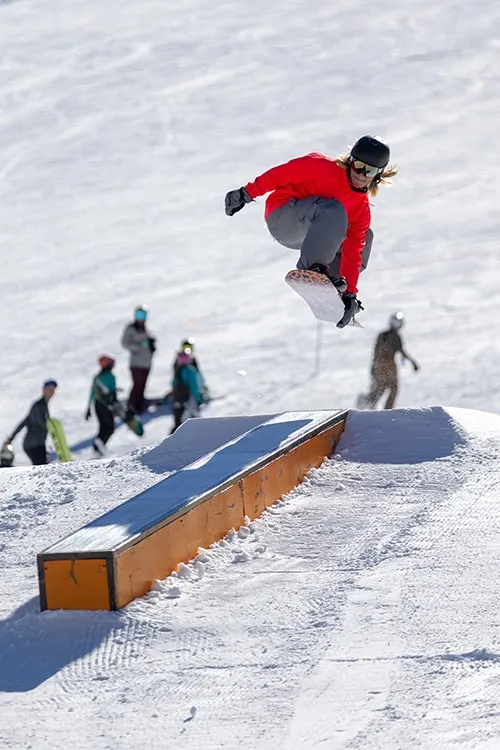
Park riders have a completely different problem: burrs. Every time your edge clips a metal rail, box lip, or jib feature, you're creating localized damage — nicks and burrs that interrupt the smooth line of your edge. A single good rail session can leave you with five or six problem spots that ruin edge feel even if the rest of the edge is perfectly maintained. Park-focused riders should be doing quick inspections and spot-filing after every park day, not waiting for a full tune.
Freeriders and backcountry riders face the rockiest (literally) proposition. One buried rock strike can create a gouge that a basic home sharpening kit can't fix. If you're riding out-of-bounds terrain or early-season conditions with questionable coverage, you need to be honest with yourself about when a shop tune is necessary versus when you can handle it at home.
The Case for Sometimes Doing Nothing
This might be the most counterintuitive thing in this whole article: sharpening too often is a real problem.
Every time you run a file or stone across your edge, you're removing metal. Edges have a finite amount of material. Over-sharpening doesn't just waste time and money — it shortens the functional life of your base and creates inconsistency in your edge bevel if you're not meticulous about maintaining the right angle every single time.
There's also a phenomenon experienced riders talk about where a freshly sharpened edge can feel almost too aggressive — grabby and twitchy in a way that actually disrupts flow until it settles in slightly. Some riders intentionally use a gummy stone to take the very sharp apex off a fresh tune, leaving the edge with a small amount of intentional detuning for a more predictable feel.
The takeaway: don't sharpen because the calendar says to. Sharpen because your edges are telling you to.
Building a Maintenance Schedule Around Real Riding Habits
Forget "every five sessions." Here's a framework that actually maps to how different riders live:
The Weekend Warrior on Groomed Terrain (1-2 days/week, hardpack focused) Do a fingernail edge check every two sessions. Expect to need a light touch-up every four to six sessions under normal conditions. Prioritize a full shop tune at the start of the season and again mid-season if you're putting in real days.
The Park Regular Check edges after every park session — no exceptions. Keep a diamond stone in your bag for quick burr removal. Full tune every eight to ten sessions or immediately after any serious rail impact.
The Powder Chaser (mostly soft conditions) Your edges are probably fine for longer than you think. Check every six to eight sessions. Be extra vigilant during early and late season when coverage is thin and rock strikes are more likely.
The Aggressive Carver (hardpack, high edge angles) You're the rider who needs the most frequent attention. Plan on a meaningful touch-up every three to four sessions. Learn to do your own light maintenance at home — it'll save you money and keep your setup dialed all season.
The Tools Worth Having
You don't need a full tuning bench to stay on top of edge maintenance. A few basics go a long way:
- A medium-grit diamond stone for regular maintenance and burr removal
- A fine-grit diamond stone for finishing passes and keeping the edge sharp between full tunes
- An edge guide if you're doing anything beyond light touch-ups — maintaining a consistent bevel angle without one is harder than it sounds
- A gummy stone for controlled detuning near the tip and tail if you want a more forgiving feel
For anything beyond light maintenance — deep gouges, significant bevel work, or a full base grind — take it to a shop. The investment in a professional tune a couple times a season is almost always worth it.
Read Your Board, Not the Calendar
The riders who keep their boards performing at the highest level aren't the ones following a rigid schedule. They're the ones who pay attention — who notice when a turn that used to feel locked-in starts to feel a little loose, who run a finger along their edge after a sketchy rock garden, who treat maintenance as a response to actual conditions rather than a routine obligation.
Your edges are talking to you every run. The question is whether you're listening.