Stick It or Quit It: The Landing Mechanics Every Intermediate Rider Needs to Master
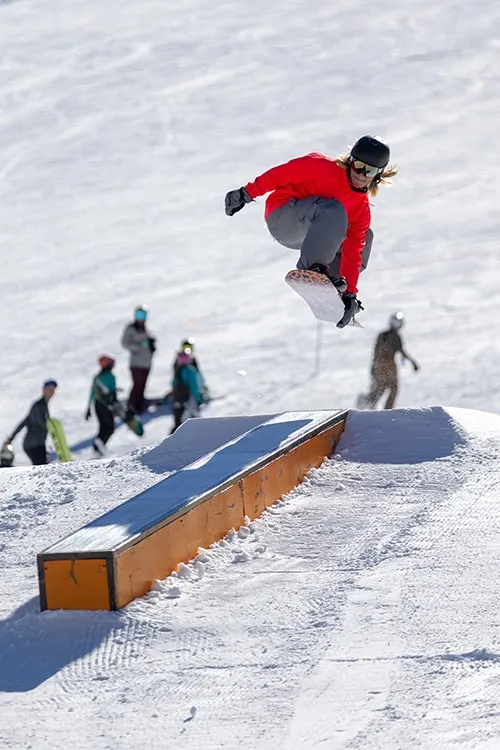
Photo: snowboarder landing jump at terrain park winter, via dodgeridge.com
Here's something nobody really wants to hear: you probably suck at landing. Not because you're a bad rider — but because almost every intermediate snowboarder out there treats the landing as a footnote to the trick itself. You spend hours visualizing the pop, the rotation, the grab. Then your board touches down and... whatever happens, happens.
That "whatever" attitude is the invisible ceiling capping your progression.
Landing mechanics aren't glamorous. Nobody posts slow-motion footage of their knees bending correctly. But if you're struggling to link tricks consistently, dealing with nagging knee or ankle soreness after park days, or finding that your progression has basically flatlined, your landings are almost certainly part of the problem. Let's break it down.
Why Landings Matter More Than the Trick Itself
Think about what's actually happening when you come down from even a modest jump. You're dropping several feet, sometimes more, with your entire body weight concentrated through a relatively small contact patch of board. The forces involved are significant — studies on action sports athletes have measured landing impact loads at anywhere from three to eight times body weight depending on drop height and technique.
Your body has a built-in shock absorption system: ankles, knees, and hips working together as a kinetic chain. When that chain functions correctly, impact gets distributed across multiple joints and muscle groups. When it breaks down — when one link is stiff, mistimed, or misaligned — all that force concentrates somewhere it shouldn't. That somewhere is usually your knees.
Beyond injury prevention, proper landing mechanics directly affect your ability to ride out of tricks. A controlled, balanced landing lets you immediately set up for whatever comes next — a turn, another feature, more speed. A survival landing just gets you to flat ground. There's a huge difference between those two outcomes, and that difference compounds over an entire run.
The Most Common Landing Mistakes Intermediate Riders Make
Straight-legging it. This is the big one. Riders who are nervous or undertrained instinctively stiffen up on the way down. Their legs lock out on impact, and instead of absorbing force, their joints take a direct hit. You can spot this mistake from the lift — it looks like the rider is trying to stomp the snow into submission rather than flow with it.
Landing in the backseat. When your weight is too far back at touchdown, your nose washes out and your heels dig in unexpectedly. This usually happens when riders pull their hips back mid-air out of anxiety. The result is either a sketchy recovery or a hard fall onto the tailbone — neither is fun.
Flat-footed impact. Experienced riders land with a slight flex in the ankle, allowing the joint to act like a spring. Beginners and intermediates often land with the whole foot hitting at once, bypassing that first level of absorption entirely.
Looking down. Your eyes should be on where you're going, not where you're landing. Dropping your gaze shifts your weight forward and forward and throws off your center of gravity right when you need it most. Keep your chin up and your vision out.
No follow-through. Landing isn't a destination, it's a transition. Riders who think "stick it" and then coast forget that every landing needs to flow into the next movement. Riding out requires active balance, not passive relief.
The Biomechanics of a Clean Landing
A proper landing isn't complicated, but it does require intentional body positioning. Here's the sequence:
-
Pre-load in the air. Before you touch down, get your knees slightly bent and your weight centered over the board. Think about drawing your feet up slightly toward your body — this loads your joints for absorption.
-
Contact with soft ankles. Your ankles should flex first, absorbing the initial shock like tiny suspension systems.
-
Knees track over toes. As you compress, your knees should bend forward in line with your feet — not caving inward (valgus collapse is a common injury pattern and a red flag in your mechanics).
-
Hips drop and center. Let your hips sink down and back slightly, like you're sitting into a squat. This engages your glutes and hamstrings to help manage the load.
-
Chest stays tall. Resist the urge to fold forward. A tall chest keeps your weight centered and your vision forward.
The whole sequence happens in about a half-second. That's why muscle memory is everything — you can't think your way through it in real time.
Drills to Build the Muscle Memory You Actually Need
Box jumps with a landing focus. Off-season or in the gym, box jumps are a classic for a reason. But instead of just jumping up, focus on the landing phase. Step off the box (start conservatively) and practice landing soft — absorbing impact quietly, knees tracking, chest tall. If your landing makes a loud thud, your mechanics need work.
The quiet landing drill on snow. Find a small, mellow jump or roller on the mountain and make it your goal to land as quietly as possible. Loud landings equal stiff joints. Silent landings mean you're absorbing correctly. This drill reframes your focus in a really useful way.
Single-leg balance work. A lot of landing instability comes from weak stabilizer muscles. Single-leg squats and single-leg balance work (even just standing on one foot on an unstable surface like a balance board or Bosu ball) builds the ankle and knee stability that makes landings feel locked in.
Trampoline time. Seriously. If you have access to a trampoline or a trampoline park, use it. The repetition of absorbing impact over and over in a low-consequence environment is incredibly effective for building the right movement patterns. Plenty of pro riders incorporate trampoline work into their off-season training.
Video review. Film your landings from the side. What you feel and what's actually happening are often very different things. Watching your own footage is humbling but genuinely one of the fastest ways to identify specific issues.
Applying Better Mechanics Across Different Terrain
Landing on a groomed run is different from landing on a powder day, and both are different from landing in the park. Soft snow is more forgiving but can also swallow your nose if your weight is back. Groomed snow is faster and less forgiving of hard impacts. Pipe landings have a specific angle you need to match to avoid washing out.
The fundamentals stay the same — soft joints, centered weight, vision forward — but you need to adapt the intensity of your absorption to the surface. Deep snow requires a bit more forward lean to keep the nose from diving. Icy landings demand even softer ankles and a slower, more deliberate transition out.
The riders who progress fastest aren't necessarily the most naturally gifted. They're the ones who've done the boring work of building a reliable foundation. Landings are that foundation. Get them right, and every other piece of your riding gets easier — the tricks feel more consistent, the falls get less frequent, and the progression you've been chasing starts to actually happen.
Ride hard. But land smarter.