The Long Game: A Realistic Progression Map for Riders Who Want to Actually Get Good
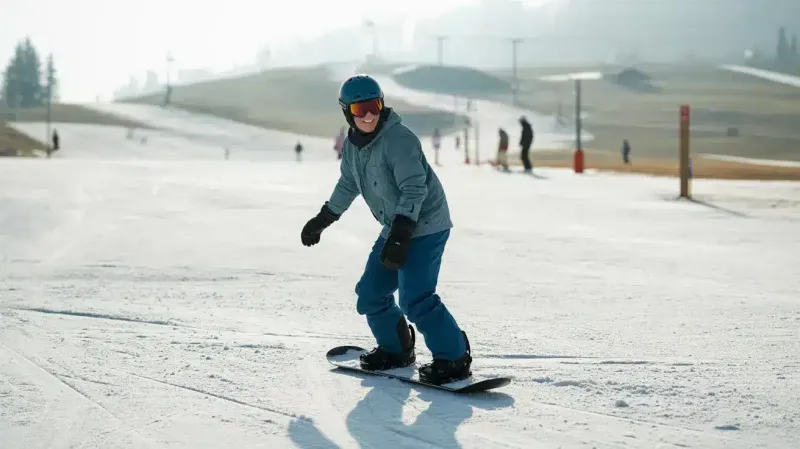
Photo: snowboarder learning on beginner slope mountain resort, via www.airkayaks.com
Every winter, thousands of people strap in for the first time convinced they'll be carving hardpack by March. Some of them saw a YouTube video. Some have a friend who "picked it up in a week." Some just have the kind of confidence that hasn't been humbled by a chairlift yet.
Then they spend day one falling on their face — literally — and suddenly the timeline feels a lot longer.
Here's the thing nobody says out loud: that's completely normal, and there's actual science behind why snowboarding takes the time it takes. The riders who progress fastest aren't the ones who push hardest. They're the ones who understand what they're actually building and stop fighting the process.
What Your Brain Is Doing When You Learn to Ride
Snowboarding is a motor skill, and motor skills are built through a neurological process called myelination. Every time you practice a movement pattern — edge transitions, weight shifts, hip alignment — your brain wraps a fatty sheath called myelin around the nerve pathways involved. More myelin means faster, more reliable signal transmission, which translates directly to smoother, more automatic movement.
The catch? Myelination takes time and repetition. You can't rush it with motivation or willpower. You can only accelerate it slightly with high-quality, focused practice. This is why a rider who does 20 intentional, focused runs on a green trail will often outpace someone who blasts 60 runs on the same hill without thinking about technique. Repetition matters, but deliberate repetition matters more.
It's also why skills you learn incorrectly are so hard to unlearn. Bad habits get myelinated too.
The Actual Milestones (Honest Version)
Forget the "shred in one season" narrative. Here's a more grounded map of what real progression looks like for most riders who ride 10 to 20 days per season.
Days 1–5: Survival Mode This phase is about learning to stop, learning to fall without destroying yourself, and starting to understand the relationship between your edges and the hill. Most beginners are riding on their heels, arms out, terrified of their toe edge. That's fine. The goal here is mileage and getting comfortable being uncomfortable.
Days 6–20: The Click Moment Somewhere in this window, something clicks. Turns start feeling intentional rather than accidental. You stop thinking about your feet constantly. Green runs feel manageable, and blues start looking possible. This is also where bad habits calcify if you're not careful — specifically, the back-seat riding and straight-leg stance that feel safe but limit everything that comes later.
Days 20–50: Green-to-Blue Transition This is where most intermediate plateaus begin. The rider can navigate blue runs but feels mechanical, inconsistent, and nervous on anything steeper or icier. The gap between what they can technically do and what they can do confidently is wide. Carving is starting to emerge but isn't yet reliable. Fall here and you start questioning your progression — don't. This is the phase that separates riders who eventually break through from those who stay stuck.
Days 50–100: The Intermediate Grind Blue runs feel comfortable. Some blacks are accessible. Park features might be entering the picture. But this range is also where many riders plateau for years because they stop pushing outside their comfort zone. The body knows how to survive the mountain. Now it needs to learn to move with it. This is where intentional drills, video feedback, and even lessons pay massive dividends.
Days 100–200+: Advanced Territory Reliable carving on hardpack, comfort in variable snow conditions, steeps and trees becoming part of the regular rotation. Riders in this range are starting to develop genuine style — the kind that comes from internalizing movement rather than executing it consciously.
200+ Days: Backcountry Readiness This isn't just a skills threshold — it's a knowledge threshold. Reading avalanche terrain, understanding snowpack, touring fitness, rescue protocols. The riding ability to handle backcountry terrain often comes before the safety knowledge to be in it responsibly. Don't let anyone rush you here, including yourself.
Why Instagram Is Lying to You
The riders you see hitting 40-foot cliffs in their "second season" edit have a few things you're probably not seeing: they often grew up skateboarding or surfing, giving them years of edge awareness and body control before they ever strapped in. They ride 50+ days a season. They fall constantly and you don't see it. And many of them are quietly nursing injuries that will catch up with them.
Comparison is the enemy of progression. Your timeline is built on your days on snow, your athletic background, your body's learning curve, and how intentionally you practice. None of those variables are the same as anyone else's.
Building Your Personal Progression Framework
Instead of measuring yourself against other riders, measure yourself against your own benchmarks. Here's a simple self-assessment approach:
Consistency check: Can you perform a skill reliably — not just when conditions are perfect, but when they're mediocre? If a skill only works 50% of the time, it's not a skill yet. It's a lucky accident.
Condition stress test: Take whatever you're working on and try it on harder snow, steeper terrain, or in lower visibility. If it falls apart, you know exactly where to focus.
Slow it down: Advanced riders can do things slowly that beginners can only do fast. If you can only link turns by building momentum, your balance and edge control still need work. Try doing it slower.
Film yourself. What you feel and what you look like are often completely different things. A five-second clip from a friend's phone will tell you more than an hour of reflection.
The Permission Slip You Didn't Know You Needed
Getting good at snowboarding takes years. Not seasons — years. That's not a discouraging fact; it's a liberating one. It means every day on the mountain is building something real, even when it doesn't feel like it. It means the rider who's been at it for three years and still working on their carve isn't behind — they're in the process.
Ride your timeline. Build the foundation right. The mountain will still be there when you're ready for the next step.