Your Stance Is Costing You: The Body Position Blueprint Every Rider Needs
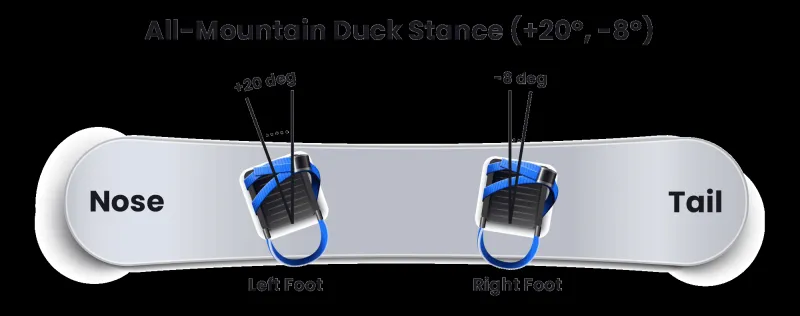
Photo: snowboarder binding stance adjustment mountain slope, via snowlink.com
Every season, riders drop serious cash chasing the perfect board — something stiffer, something more responsive, something that'll finally make their riding click. And every season, those same riders strap into their new setup with the exact same stance they've had since 2015 and wonder why things don't feel quite right.
Here's the uncomfortable truth: your board flex matters a lot less than where your feet are planted and what your body is doing on top of it. Stance is the foundation of everything. Get it wrong, and no amount of carbon fiber or camber profile will save you.
Why Stance Deserves More Respect
Think of your stance as the operating system your riding runs on. Board choice, binding selection, even your boot stiffness — those are all apps running on top of it. If the OS is misconfigured, nothing performs the way it should.
Stance width directly affects your center of gravity. A wider stance drops you lower, increases lateral stability, and gives you a more grounded feel — great for park, pipe, and aggressive all-mountain charging. A narrower stance raises your hips, allows for quicker edge-to-edge transitions, and puts more leverage into your turns. Neither is universally better. What matters is whether yours matches your riding style and the terrain you're on.
Binding angles are equally critical and wildly misunderstood. Most beginner setups ship with something close to a duck stance — both feet angled outward symmetrically, say +15° front and -15° rear. That's a reasonable starting point for learning, but it's not a permanent answer. As you progress, your preferred terrain and technique will pull you toward adjustments that most riders never make simply because nobody told them to look.
The Biomechanics Behind the Setup
Let's get into what's actually happening when you ride. When you initiate a toeside turn, you're dorsiflexing your front ankle and driving your knee forward while your rear hip opens up and your upper body follows. If your binding angles are fighting that movement — say, your front foot is angled too far forward for your natural hip rotation — you'll feel it as tension in your lower back and hips, or as a turn that never quite engages cleanly.
Your body has a natural athletic stance. Stand up right now and jump an inch off the ground. When you land, notice where your feet go — that's your body's default power position. The width of that landing is probably close to where your stance should be. Most people land with feet roughly shoulder-width apart, sometimes slightly wider. If your snowboard stance is dramatically different from that, your body is working against itself every time you load into a turn or absorb a bump.
Forward lean on your highbacks plays into this too. More forward lean pre-loads your calves and puts you in a more aggressive, forward-weighted position. That's fantastic for carving groomers at Vail or Park City, but it'll wear you out fast in deep powder where you need to sit back and let the nose float.
Diagnosing Your Own Setup
You don't need a biomechanics lab to figure out if something's off. Here are a few real-world diagnostic questions:
Do your knees track over your toes on heel-side turns? If your front knee is collapsing inward, your front binding angle might be too centered or your stance too narrow. Try widening your stance by half an inch on each side and rotating your front foot a few degrees more toward the nose.
Do you feel like you're fighting your back foot on toe-side turns? Your rear binding angle might be too neutral. Rotating it a few degrees in either direction — depending on your dominant riding direction — can open up your hips and make the whole turn feel more natural.
Are you fatiguing quickly on long groomers? You might be riding in a stance that forces your muscles to constantly compensate for a misaligned position. Efficient stance means your skeleton does more of the work, not just your quads.
Are landings jarring and hard to stick? A stance that's too narrow reduces your base of support. On landings, you want that wider, lower platform to absorb impact across both legs evenly.
Making Adjustments Without Overthinking It
The good news is that binding adjustments take about ten minutes and a screwdriver. The bad news is that most people make one change, ride it once, and either hate it immediately or declare victory too soon. Give any adjustment at least two or three full sessions before evaluating it. Your body needs time to recalibrate.
A practical approach: start with your stance width. Get it close to shoulder-width — measure it, don't eyeball it. Then assess your binding angles. If you ride mostly frontside on groomed runs, try something like +18° front and -6° rear. If you're a park rider or love switch riding, go more symmetrical, like +12° and -12°. Powder riders often benefit from a more directional setup, pushing the stance back slightly on the board and running a more forward front angle.
Once width and angles feel right, revisit your highback lean and your boot strap tension. These are the fine-tuning knobs that most riders ignore entirely.
The Bigger Picture
Here at Powe Snowboards, we're all about riding hard and riding smart — and riding smart means understanding that the most important piece of equipment you bring to the mountain is your own body. Your board is a tool. Your stance is the skill.
The riders who consistently progress aren't always the ones with the newest gear. They're the ones who've taken the time to understand how their body interacts with their setup and made deliberate, thoughtful adjustments along the way.
Next time you're not feeling dialed in on the mountain, resist the urge to blame the board. Step back, look at your stance, and ask whether your foundation is actually set up to let you ride the way you want to. Chances are, that's where the answer is hiding.