Park Ladder: Five Features to Lock Down Before You Chase Big Lines
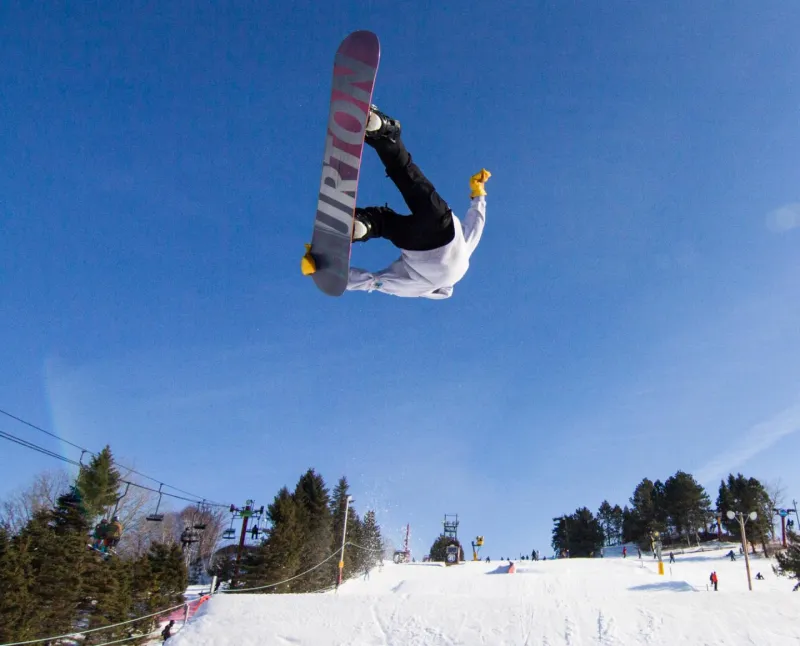
Photo: snowboarder hitting small terrain park jump sunny day, via www.littleswitz.com
Every terrain park has that one rider who bee-lines for the big line on day one and spends the rest of the season on the bench with a wrist brace. Don't be that rider. The park rewards patience in a way the rest of the mountain doesn't, and the features below are the actual foundation — skip them and everything above gets sketchy.
1. Flat-Ground Ollies and Nollies
Yes, really. The ollie is the jumping motion of snowboarding, and a weak one poisons everything — jumps, rails, powder, all of it. Most riders ollie by slamming the tail and hoping. The right way is a load-pop-retract rhythm: compress, pop off the tail, then suck your knees up so the board comes with you.
Common mistake: Popping and immediately stiffening up. Drill: Ten ollies per run on every cat track, focusing on height and landing balanced, not just getting airborne.
2. Small Jumps — Straight Airs With Intention
The smallest jump in the park, ridden until it's boring. That's the assignment. Approach with a flat base, pop off the lip, spot your landing, and stomp with your weight centered. Speed control is the hidden skill here — ask someone what speed they're carrying, watch a few riders, and commit. Hesitating mid-approach is how people get hurt.
Common mistake: Leaning back on the lip "for safety," which actually sends your nose down on landing. Drill: Same jump, ten straight airs, then ten with a grab. Grabs force you to be comfortable in the air.
3. Boxes Before Rails
Flat boxes teach you the rail motion without the punishment. Approach straight, stay flat-based, keep your weight slightly centered and your eyes on the end of the feature — not your feet. The board does the rest.
Common mistake: Looking down at the board, which shifts your weight and guarantees a slip-out. Drill: Fifty-fifties on the widest, flattest box until you can do them at three different speeds without thinking.
4. Small Transition Features and Spine Airs
Halfpipe-style walls and spines teach you how to use transition — pumping with your legs instead of just riding through. This is the skill most park riders skip entirely, and it's why their jumps plateau. Learn to pump a small wall and you'll understand what "pop off the lip" actually means.
Common mistake: Standing tall and rigid through the transition, absorbing nothing. Drill: Ride the smallest wall repeatedly, focusing only on extending your legs as you go up the transition.
5. 180s Off Small Jumps
Now you can spin — but only off something you've already mastered. A frontside 180 off a tiny jump combines the pop from step one, the air awareness from step two, and the landing discipline you've been building all along. Ride away switch, because the landing is the trick.
Common mistake: Spinning with your shoulders only and hoping your legs follow. Drill: Wind up slightly with the lead shoulder, then unwind through the pop. Practice riding switch until it stops feeling foreign.
The Ladder Only Works in Order
Each rung exists because the next one needs it. Ollies make jumps make sense. Jumps make boxes make sense. Transition makes everything bigger possible. Take one season to work this ladder honestly and the big line stops being a gamble — it becomes a choice.